- Home
- Essential Oil Profiles
- Spike Lavender Essential Oil
As an affiliate for Bookshop, Amazon, and other programs, I may earn a small commission for products purchased through links. Privacy policy and disclosures.
Spike Lavender Essential Oil Benefits and Uses in Aromatherapy
Spike lavender essential oil (Lavandula latifolia) is a stimulating oil that contains more camphor and 1,8-cineole than true lavender (Lavandula angustifolia) essential oil or lavandin (Lavandula x intermedia) essential oil.
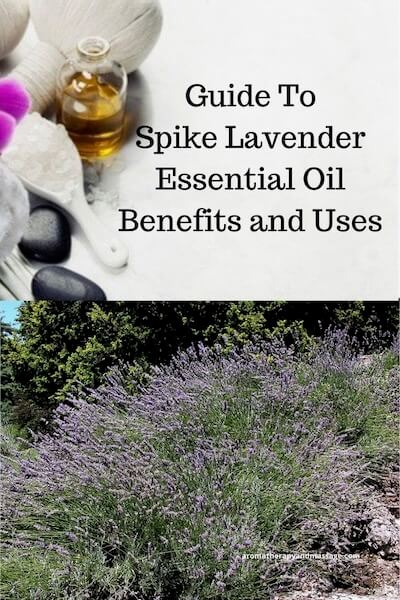
This composition makes spike lavender especially useful for relieving respiratory issues and muscle aches and pains. However, you do not want to use this stimulating oil for insomnia, stress reduction, or calming the mind.
Basic Spike Lavender Facts
Plant family: Lamiaceae.
Production: Steam distilled from the buds/flowering tops of the plant. The plant yields much more essential oil than the true lavender plant. Spike lavender is sometimes used to adulterate true lavender oil to lower cost.
Aroma: Floral, camphorous, but harsher than true lavender.
Perfume/Aromatic note: Top to middle.
Is spike lavender safe to use during pregnancy? No, according to Aromatica: A Clinical Guide to Essential Oil Therapeutics, Vol. I (p. 231), based on the camphor content.
Is spike lavender safe for children? Do not use with babies and young children.
Main components:
- linalool 27.2–43.1%
- 1,8-cineole 28.0–34.9%
- camphor 10.8–23.2%
Source: Essential Oil Safety, 2nd Ed. The book cautions that spike lavender with a high camphor content may have mild neurotoxic effects, though the linalool content may mitigate those effects.
Spike Lavender Essential Oil Benefits
Spike lavender is stimulating and warming. The oil's primary uses are for weak and cold conditions, especially ones involving the nervous, respiratory, cardiovascular, or gastrointestinal systems, according to Aromatica.
Commonly mentioned benefits of spike lavender include:
- Pain relief: eases muscle and joint aches, pains, spasms, and cramps; headaches; and rheumatism.
- Respiratory support: soothes allergies and sinus congestion, clears mucus and congestion, and relieves cold symptoms, including sore throats and coughs.
- Skin care: helps heal acne, insect bites, cuts & scrapes, athlete's foot, and other skin fungus.
- Circulatory support: calms inflammation and encourages circulation.
- Mental support: promotes motivation and energy.
- Insect repellent.
Sources:
- 375 Essential Oils and Hydrosols
- Aromatherapy: A Complete Guide to the Healing Art
- The Heart of Aromatherapy
- The Complete Book of Essential Oils and Aromatherapy
- The Complete Aromatherapy and Essential Oils Handbook for Everyday Wellness
Energetically, spike lavender grounds and purifies, enhancing intuition and awareness for clairvoyance, psychic work, and dreamwork, according to Mixing Essential Oils for Magic. The oil also aids concentration to bring inspiration and clarity for spirit contact, divination, and communication in general.
Spike Lavender Essential Oil Uses and Blends
The Complete Guide to Aromatherapy, Third Edition, Vol. 1, suggests blending the following essential oils with spike lavender:
- For an insect repellent: atlas cedarwood, citronella, lemon-scented tea tree, niaouli, peppermint, or tea tree.
- To relieve muscle, arthritic, or rheumatic pain: black pepper, ginger, kunzea, peppermint, or rosemary.
- To relieve headaches: kunzea, lavender, sweet marjoram, or peppermint.
- To relieve general fatigue: black pepper, coriander seed, ginger, lemon, peppermint, or rosemary.
To relieve cold symptoms, combine spike lavender in a carrier oil with thyme linalool essential oil for chest massage, according to Advanced Aromatherapy.
Muscle Blends
Sore Muscle Oil
- 2 tablespoons trauma oil
- 7 drops spike lavender essential oil
- 4 drops black spruce essential oil
- 4 drops myrtle essential oil
- 3 drops ginger essential oil
Blend all ingredients in a one-ounce (30-ml) glass bottle. Cap the bottle and shake gently. Massage onto sore muscles as needed.
Source: The Heart of Aromatherapy
Sore Muscle Relief
- 2 tablespoons jojoba oil
- 4 drops spike lavender essential oil
- 4 drops rosemary ct. camphor essential oil
- 2 drops ginger essential oil
Blend all ingredients in a one-ounce (30-ml) glass bottle. Cap the bottle and shake gently. Use as needed.
Safety: This blend is a 2% dilution. Use caution if you have epilepsy or are pregnant or nursing. Patch test recommended. Safe for kids 10 and over.
Source: Aromatics
Sore Muscle Blend
- 2 tablespoons trauma oil
- 7 drops spike lavender
- 7 drops carrot seed essential oil
- 1 drop clove bud oil
Blend all ingredients in a one-ounce (30-ml) glass bottle. Cap the bottle and shake gently. Use as needed.
Safety: This blend is a 3% dilution. Use caution if you have asthma, epilepsy, impaired liver function, or a clotting disorder or are pregnant or nursing. Best not used on broken skin. May cause photosensitivity. Patch test recommended. Safe for kids 10 and over.
Source: Aromatics
Respiratory Blends
Respiratory Diffuser Blend
Diffuse a few drops of this blend to help relieve symptoms of flu, bronchitis, or sinusitis or to purify the air.
- 25 drops spike lavender
- 50 drops eucalyptus globulus essential oil
- 20 drops pine essential oil
- 5 drops thyme essential oil
Blend the essential oils in a 5-ml amber bottle.
Source: E. Joy Bowles, PhD, BSc (Hons). "Alpha and Beta Pinene." International Journal of Professional Holistic Aromatherapy, Summer 2012, p. 13.
Breathe Deep Steam Inhalation
This blend soothes sinuses irritated by pollen and also makes a stimulating facial steam.
- 3 drops spike lavender essential oil
- 4 drops lemon essential oil
- 2 drops eucalyptus globulus essential oil
- 1 drop rosemary essential oil
- Blend essential oils in a small dish.
- Add the blend to a bowl of steamy water.
- Cover your head with a towel or cloth, creating a tent where the fragrant steam can linger.
- Close your eyes and lean carefully (not too close!) over the steamy bowl.
- Take cautious inhalations through your mouth and nose until you can comfortably breathe deeply through your nose.
- Repeat up to 3 times a day.
Source: Katie Vie. "Seasonal Self Care." NAHA Aromatherapy Journal, Spring 2013.1, p. 6.
Mosquito Repellent
- 1 teaspoon neem oil
- 12 drops spike lavender
- 12 drops lemon eucalyptus (Eucalyptus citriodora) essential oil
Blend oils. To use, lightly moisten your hands and put a few drops of the blend in your palm. Vigorously rub hands together. Apply oil to your body and face, avoiding the eyes. Repeat as often as needed.
Adapted from The Essential Guide to Natural Skin Care.
About the Author

Carol Wiley is a retired massage therapist and freelance writer. She uses her deep interest in aromatherapy and essential oils to research their benefits and uses and bring you summaries and blends with links to more resources.
If you find this site useful, you can show your support by buying through my affiliate links. The site is a labor of love, and I appreciate any income that helps keep it up and running.
Buy essential oils at Aromatics International or Rocky Mountain Oils.
Buy massage supplies at Massage Naturals.
Buy anything at Amazon.
You might like these
Ylang Ylang Essential Oil Benefits and Uses In Aromatherapy
Understand the benefits and uses of ylang ylang essential oil, including acting as an aphrodisiac, balancing all skin and hair types, and relaxing muscles.
Lemon Essential Oil Benefits and Uses In Aromatherapy
The bright, uplifting, clean aroma of lemon essential oil makes it great for energizing, cleaning, clearing the air and the body, and more.
Sage Essential Oil Benefits and Uses In Aromatherapy
Sage essential oil has uses and benefits in aromatherapy but must be used with caution due to its components. Learn more about how to use sage safely.

Photo Credit: Andrea Moro, CC BY-SA 4.0, via Wikimedia Commons
