- Home
- Essential Oil Profiles
- Spanish Lavender
As an affiliate for Bookshop, Amazon, and other programs, I may earn a small commission for products purchased through links. Privacy policy and disclosures.
Spanish Lavender Essential Oil Benefits and Uses in Aromatherapy
Unlike the essential oils of true lavender (Lavandula angustifolia), lavandin (Lavandula x intermedia), and spike lavender (Lavandula latifolia), Spanish lavender essential oil (Lavandula stoechas) contains more than 50% ketones. The oil is sometimes referred to as French lavender, even though that name is not technically correct.
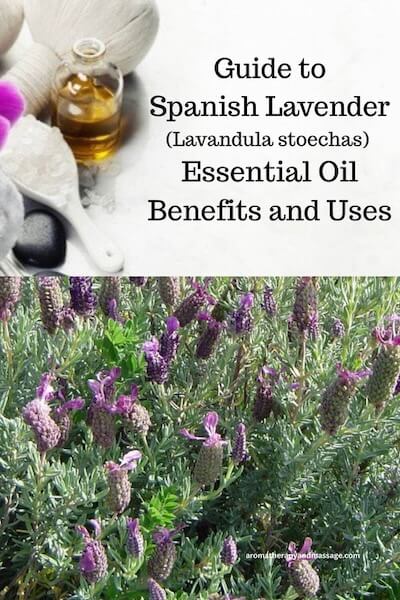
The oil may also be called Seville, stoke, or butterfly lavender. The name Seville lavender is most commonly used to refer to Lavandula stoechas subsp. luisieri (Rozeira) Rozeira. The other commonly used subspecies for essential oil is Lavandula stoechas subsp. stoechas.
Basic Spanish Lavender Facts
Plant family: Lamiaceae.
Production: Steam distilled from flowering tops of the plant.
Aroma: Camphor-like, with floral, woody, herb-like hints. Sometimes described as a sharp, medicinal scent.
Perfume/Aromatic note: Middle to top.
Is Spanish lavender safe to use during pregnancy? No, and do not use while breastfeeding, according to Essential Oil Safety, 2nd Edition.
Is Spanish lavender safe for children? Do not use with babies or young children, according to several sources. Consult a professional.
Cautions: Contemporary French Aromatherapy states not to use Spanish lavender if you have a neurological condition. Some sources suggest only professionals use the oil because of potential neurotoxic effects if the oil is used improperly.
Main components:
- Camphor 16.4–56.2%
- Fenchone 14.9–49.1%
- Cineole 3.6–14.5%
Source: Essential Oil Safety, 2nd Ed.
Spanish Lavender Essential Oil Benefits
Aromatica: A Clinical Guide to Essential Oil Therapeutics, Vol. I: Spanish lavender supports healing of wounds, eczema, sores, and similar skin conditions. This essential oil stimulates the thinning and loosening of mucus in the airways and is useful for bronchitis and sinusitis. The oil is also a general restorative or tonic for hypotonic (weak) conditions.
Essential Oils and Aromatherapy for Dummies: Spanish lavender is a strong wound healer that also helps ease sore muscles. The oil is especially effective on acne.
375 Essential Oils and Hydrosols: This essential oil is indicated for earache, eczema, and chronic sinusitis.
The Complete Aromatherapy & Essential Oils Handbook for Everyday Wellness: Spanish lavender is useful for relieving aches and pains and helps suppress coughing and loosen mucus. This oil stimulates the central nervous system and can help reduce fatigue and mental exhaustion.
Energetically, Spanish lavender benefits the third chakra (personal power) and sixth chakra (perspective, clarity, protection, purification), according to Stillpoint Aromatics.
Spanish Lavender Essential Oil Uses and Blends
Lavandula stoechas is commonly used in insecticides, insect repellents, and air freshening products.
Suggested respiratory support diffuser blend:
- 3 drops Spanish lavender
- 3 drops peppermint essential oil
- 2 drops lemon essential oil
- 2 drops eucalyptus essential oil
Use according to your diffuser's instructions.
NYC Aromatica suggests the following uses for Spanish lavender essential oil:
- Add to topical products for easing aches, pains, and inflammation.
- Add to blends to support respiratory health, especially when an infection includes stuck, sticky mucus.
- Add to blends to calm the mind or boost confidence and self-acceptance, especially if you need to let go of funky-stuck-down moods.
The following blends are adapted from NYC Aromatica.
Clear the Mind and Support Joy
- 4 drops Spanish lavender
- 6 drops petitgrain (Citrus aurantium var amara) essential oil
- 2 drops clary sage (Salvia sclarea) essential oil
- Carrier oil
Add essential oils to a 10-ml rollerball. Fill with a carrier oil. Cap and shake. Apply to neck and shoulders or other areas, as desired.
Pain Relief Blend
Use this blend to help relieve acute pain. Add the following to a 2-ounce glass bottle:
- 4 tablespoons (2 ounces) trauma oil
- 20 drops Spanish lavender essential oil
- 15 drops black pepper essential oil
- 10 drops sweet marjoram essential oil
- 10 drops plai essential oil
- 5 drops clove bud essential oil
Balancing Relaxation Spray
Add the following essential oils to a 2-ounce glass spray bottle:
- 15 drops Spanish lavender
- 12 drops hops (Humulus lupus) essential oil
- 5 drops vetiver essential oil
Fill the bottle with distilled water. Cap and shake before each use. Use as a body mist, avoiding eyes and other sensitive areas, or as a room spray.
For a detailed look at the Spanish lavender plant, see A Phytopharmacological review of a Mediterranean plant: Lavandula stoechas L.
About the Author
Carol Wiley is a retired massage therapist and freelance writer. She uses her deep interest in aromatherapy and essential oils to research their benefits and uses and bring you summaries and blends with links to more resources.
If you find this site useful, you can show your support by buying through my affiliate links. The site is a labor of love, and I appreciate any income that helps keep it up and running.
Buy essential oils at Aromatics International or Rocky Mountain Oils.
Buy massage supplies at Massage Naturals.
Buy anything at Amazon.
You might like these
Ylang Ylang Essential Oil Benefits and Uses In Aromatherapy
Understand the benefits and uses of ylang ylang essential oil, including acting as an aphrodisiac, balancing all skin and hair types, and relaxing muscles.
Lemon Essential Oil Benefits and Uses In Aromatherapy
The bright, uplifting, clean aroma of lemon essential oil makes it great for energizing, cleaning, clearing the air and the body, and more.
Sage Essential Oil Benefits and Uses In Aromatherapy
Sage essential oil has uses and benefits in aromatherapy but must be used with caution due to its components. Learn more about how to use sage safely.
Lavandula stoechas Photo Credit: User:Xemenendura, CC BY-SA 2.1 ES, via Wikimedia Commons.
