- Home
- Asian Massage
- Jin Shin
As an affiliate for Bookshop, Amazon, and other programs, I may earn a small commission for products purchased through links. Privacy policy and disclosures.
What Is the Difference Between Jin Shin Jyutsu and Jin Shin Do?
Jin Shin Jyutsu® is an energy healing and acupressure technique with origins in ancient Japan.
Jin Shin Do® is a style of acupressure and emotional release developed by American psychotherapist Iona Marsaa Teeguarden starting in 1976, partially based on Jin Shin Jyutsu.
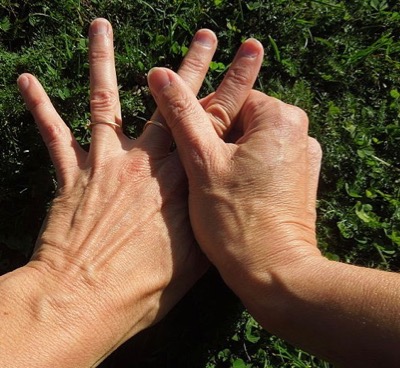 A hand mudra used in Jin Shin Jyutsu.
What is Jin Shin Jyutsu?
Jin Shin Jyutsu is a gentle energy therapy where practitioners place their hands on designated points on your body. The purpose is to bring harmony and balance to your body's energy so your body can heal itself. You can also practice the technique on yourself.
Although the origins of this technique are ancient, in the early 1900s Japanese scholar Jiro Murai organized the technique and began training students. One of Murai's students in the 1950s was Mary Burmeister. She brought the technique to the United States and offers training through Jin Shin Jyutsu, Inc.
The goal of Jin Shin Jyutsu is to stimulate energy (ki) movement among the body's 26 "safety energy locations" (SELs). These locations are similar to the acupoints of Chinese Medicine and are located on energy pathways (similar to meridians). Practitioners use very little pressure on the SELs, and their hands act like jumper cables that unblock the energy flow or redirect it.
A session starts with you lying on your back, fully clothed. The practitioner feels the energy pulses in your wrists, which indicate your body’s current balance, and decides which SELs to use to bring you into more harmony.
Jin Shin Jyutsu translates as "the Art of the Creator through the person of compassion." In The Touch of Healing, author Alice Burmeister states that this art helps you find the perfect expression of harmony that exists within you. Core concepts include:
- The life energy that circulates throughout the universe and within each organism manifests at varying levels of density called depths.
- Breath is the basic expression of life energy.
- Obstructions, caused by attitudes, to life energy lead to physical, mental, and emotional disharmony. The five basic obstructive attitudes are anger, fear, sadness, pretense, and worry.
- Life energy moves through the body in distinct pathways called flows. Energy moves down the front of the body and up the back in a continuous oval.
- The SELs act as circuit breakers to protect the body when the flow of energy is blocked.
- Disharmony comes in many forms, which we give labels such as a cold, indigestion, or even cancer or heart disease), but all arise from a blockage of energy.
What is Jin Shin Do?
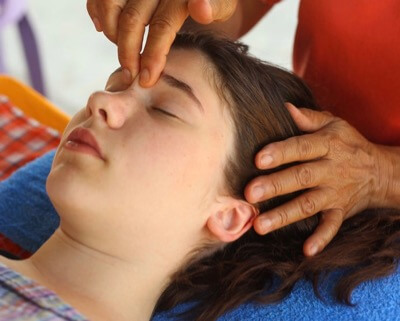 Practitioner holding Jin Shin acupressure points on a woman's face.
Jin Shin Do combines the use of pressure on specific points with breathing and body-focusing techniques to release bodymind armoring.
The technique is a style of acupressure developed by Iona Marsaa Teeguarden. It's based, in part, on Jin Shin Jyutsu and the body armoring theories of Wilhelm Reich. According to Teeguarden, her system emphasizes a bodymind approach that views the unity of the body and psyche through both Western and Eastern lenses.
Practitioners use one hand to hold a point inside the tense area they want to release. At the same time they use the other hand to hold distant points that help the tense area release more readily. The distal points are either on the same strange flow or organ meridian as the local point or are functionally related.
Jin Shin Do is the only type of acupressure to select points based on the main balancing channels called the strange flows or extraordinary meridians, which are:
- Great Central Channel (Vessel of Conception and the Governing Vessel)
- Great Regulator Channel (Yin and Yang Wei Mo)
- Great Bridge Channel (Yin and Yang Chiao Mo)
- Penetrating and Belt Channels (Cha’ng Mo and Tai Mo)
Working with the strange flows balances the body's excesses and deficiencies.
The Emotional Component
In Reichian theory, armoring is chronic tension that limits your mobility and ability to feel. Armoring develops when you are unable to express emotions. You suppress feelings by tightening muscles, which eventually become rigid and develop fascial adhesions.
Tight muscles start to affect related muscles, creating rings of armoring. The armoring then interferes with energy flow in your body, leading Teeguarden to combine Western psychological concepts and Eastern energy theory.
Teeguarden also incorporated the Emotional Kaleidoscope, based on the Chinese Five Elements theory, that correlates 100 different feelings and emotions with the 12 organ meridians. This kaleidoscope helps the practitioner understand the relationship of specific meridians to specific feelings and attitudes, letting the practitioner more readily follow your individual release process.
Jin Shin Do Sessions
Sessions usually last from one to 1.5 hours. Typically, you lie, fully clothed, face up on a massage table. The practitioner checks your pulses to determine which meridians are overactive and which are underactive and then uses touch (palpation) to identify tension patterns and points of restriction.
With one hand, the practitioner holds a local point located in a tense area while using the other hand to hold a distal point or points, typically holding points for about one to three minutes. The pressure is firm but gentle, with the goal of bringing your awareness into the tense part of your body so you can release the tension from the inside out.
The practitioner increases the pressure as the muscle releases to gradually help layers of armoring let go. However, the practitioner never uses more pressure than you find comfortable. Because these releases can bring up feelings, practitioners receive training in basic skills such as active listening and an understanding of the power of words.
More information, practitioner referrals, and training is available through the Jin Shin Do® Foundation for Bodymind Acupressure®.
Sources: Articles by Teeguarden in Massage and Bodywork, Spring 1995, and Massage Magazine, November/December 1998, plus Teeguarden's The Joy of Feeling: Bodymind Acupressure.
About the Author

Carol Wiley is a retired massage therapist and freelance writer with a deep interest in essential oils. She uses her experience and knowledge, along with research, to bring you information about aromatherapy and massage and links to more resources.
If you find this site useful, you can show your support by buying through my affiliate links. The site is a labor of love, and I appreciate any income that helps keep it up and running.
Buy essential oils at Aromatics International or Rocky Mountain Oils.
Buy massage supplies at Massage Naturals.
Buy anything at Amazon.
You might like these
History of Massage Therapy
The history of massage therapy spans centuries. Learn more about the development of massage through time.
Massage for Children - Benefits of & Guidelines for Pediatric Massage
Pediatric massage, or massage for children, has many benefits, including reducing stress, anxiety, and chronic pain. Learn more...
Breema Bodywork: Reconnecting with Vitality
The rhythmic movement sequences of Breema bodywork release tension, help improve physical health, and increase vitality by enhancing the flow of life energy.

Hand Mudra Photo Credit: Isabelle Ducau - Own work, CC BY-SA 4.0
Jin Shin Acupressure Photo Credit: Yuliya Lapkovkaya / 123RF Stock Photo
