- Home
- Essential Oil Profiles
- Calendula Oil
As an affiliate for Bookshop, Amazon, and other programs, I may earn a small commission for products purchased through links. Privacy policy and disclosures.
Calendula Oil Benefits and Uses: Essential Oil, CO2 Extract, Absolute, and Infused Oil
True calendula essential oil is rare. Most calendula oil products used in aromatherapy and skin care are an infused oil, CO2 extract, or absolute. Although all these products have similar calendula oil benefits, the specifics vary and can affect what will work best for you.
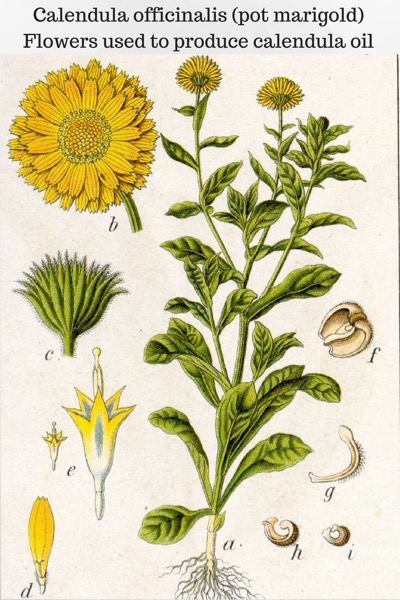
Types of Calendula Oil
The essential oil must be steam-distilled from the flower petals of the pot marigold (Calendula officinalis). However, these delicate flowers are difficult—some people say nearly impossible—to steam-distill. You are more likely to find:
- Calendula-infused oil (also called a macerated or herbal oil) is made by infusing calendula flowers into a fatty oil such as jojoba or extra-virgin olive oil. The infused oil is safe and gentle for all ages and commonly used in skin care products, with or without essential oils.
- Calendula CO2 extract is made using supercritical CO2 extraction, which pulls a broader range of compounds out of the plant than steam distillation.
- Calendula absolute is solvent-extracted using a chemical solvent and commonly used in perfumery, although you can use the oil in skin care.
Because the major active components of calendula—faradiol esters and carotenes—are not volatile and not extracted by steam distillation, the CO2 extract and infused oil are the most useful types of calendula for skin care.
It's important to recognize the differences between the oils and know what you're buying. Be cautious, as some products labeled calendula essential oil may be a mislabeled infused oil, CO2 extract diluted in carrier oil, or fragrance product rather than a true essential oil. Always check the method of production—if the oil is not steam-distilled, it's not an essential oil. Unfortunately, the marketplace is a bit confusing and not every company is fully transparent.
Basic Calendula Oil Facts
Calendula oil is sometimes called marigold oil.
Important: Do not confuse pot marigold (Calendula officinalis) with French or Mexican marigold (Tagetes patula, Tagetes minuta, or Tagetes erecta). Tagetes essential oil is also available but has properties that differ from those of calendula.
Plant family: Asteraceae (the daisy family). If you have allergies to plants in this family, which includes ragweed, proceed with caution. Do a patch test on a small area of skin before using any type of calendula oil.
Is calendula oil safe to use during pregnancy? Do not use the essential oil, CO2 extract, or absolute without consulting a professional. You can use calendula-infused oil. Aromatherapy and Massage for Mother and Baby recommends using the infused oil as part of a cream for sore and cracked nipples.
Is calendula oil safe for children? The infused oil is safe. The other oils are probably safe when appropriately diluted. Consult a professional.
Calendula Essential Oil and Absolute
Calendula absolute is useful for skin care, including burns, cuts, eczema, insect bites, rashes, and wounds, according to The Encyclopedia of Essential Oils (updated edition). The book describes the absolute as a dark greenish-brown, viscous liquid that contains calendulin (a yellow resin), waxes, and volatile oils. The aroma is intense, sharp, and herbaceous.
Veda Oils is one of the few sources I found that claims to offer a steam-distilled calendula essential oil. (Most other product pages titled Calendula Essential Oil were actually offering something different.) Veda suggests using the oil to scent perfumes, soaps, candles, and natural bath oils and in skin and hair care products to support healthy skin and scalp.
Spiritually, pot marigold supports vision and prophecy, according to Sacred Oils. The oil can help you get to the root of a problem or situation, protect against negative emotions, and give you insight into the future. The oil has an affinity with the sixth (third eye) chakra.
For minor wounds:
- 3 drops helichrysum essential oil
- 1 drop calendula essential oil or absolute
- 1 teaspoon tamanu oil
- 1 teaspoon coconut oil
- 1 teaspoon rosehip seed oil
Blend all ingredients in a small, dark glass bottle. Apply a little of the blend to the wound several times a day.
Calendula CO2 Extract Benefits and Uses
Calendula CO2 extract is a rich, dark orange color with a light, dry aroma and notes ranging from sweet grass to hay-like. The oil is viscous, almost solid, and can be challenging to work with. You need to warm the bottle to disperse the oil.
Eden's Botanicals indicates calendula CO2 total extract becomes pourable at about 104ºF. Essential Guide to Natural Skin Care states calendula CO2 select extract is easier to work with (not as thick), but I could not find a select extract for sale.
Some suppliers sell the extract already diluted in a carrier oil, typically at 10%. If you buy an already-diluted extract, you may need to adjust blends. A typical recommendation for using the CO2 extract in a blend is 1 to 3% of the total carrier oil base.
Calendula extract skin benefits include inflammation-fighting properties that may help heal acne, eczema, dermatitis, skin inflammations, couperose skin, wounds, scarring, bee stings, and burns. The oil is also useful for aged, damaged, dry, and mature skin.
Main components of the CO2 extract:
- Faradiol esters 17–25%
- Taraxasterol and amyrin 4.8–10.7%
- Sterols 1.3–1.5%
- Carotenoids 0.85–1.2%
- Essential oils (up to 0.4%) and cuticular waxes (partially responsible for the thick viscosity)
Sources: The Carrier Oil Palette: Fixed Oils, Butters, Herbal Oils, and CO2 Extracts by Jade Shutes and "Calendula," Guba Essential News, Vol. 10, Sept. 2002, pp. 3–4.
Calendula Oil for Face Care
- 1 tablespoon jojoba oil
- 1 tablespoon rosehip seed oil
- 5 drops vitamin E oil
- 10 drops calendula CO2 extract
- In a small glass bottle, combine the jojoba oil, rosehip seed oil, and vitamin E oil.
- Add the calendula CO2. Cap and shake well to blend.
- Let sit in a cool, dark place for 24 hours to let the oils synergize.
To use, gently massage a few drops on clean, damp skin each morning and evening.
Source: Clover Aroma
For more blends using the CO2 extract, see Eden Botanicals' calendula recipes.
Calendula-Infused Oil Benefits and Uses
You can use calendula-infused oil alone or as a carrier in essential oil blends for skin care. Benefits of calendula oil for the skin include softening, soothing, regenerating, reducing risk of infection, relieving inflammation, and promoting circulation, according to Essential Guide to Natural Skin Care.
Use calendula for these skin types and conditions: dry, sensitive, irritated, chapped, mature, wrinkled, damaged, scarred, prone to acne, and prone to couperose. You can also use calendula-infused oil for after-sun skin care and as a general massage oil.
Calendula-infused oil has exceptional wound-healing and tissue-repair properties. Other calendula oil uses for the skin include:
- Cracked nipples due to breastfeeding (nontoxic to babies)
- Chapped skin, chronically dry or cracked skin
- Cuts, scrapes, minor burns, abrasions, and minor skin irritations
- Damaged tissue, ulcers
- Diaper rash
- Dry, damaged hair
- Fungus
- Inflamed skin conditions, such as eczema and dermatitis
- Insect bites
- Rough feet and calluses
- Varicose veins
You can also use calendula oil for hair care. Purported benefits include moisturizing and reducing dandruff.
Calendula-infused oil is a useful addition to skin care balms, salves, creams, oils, lotions, and gels. Use the oil in gentle baby care products, first-aid formulations, and shampoos. For blends using calendula, see:
Infused-Oil Sources and More Information
- The Calendula E-Book by Jade Shutes
- Exploring Aromatic Herbal Oils by Jade Shutes
- The Nerdy Farm Wife's Things To Do With Calendula
- The Complete Book of Essential Oils and Aromatherapy
Calendula Research
"A Review on Traditional Uses, Phytochemistry and Pharmacological Activities of Calendula officinalis Linn" (2024) at https://journals.sagepub.com/doi/10.1177/1934578X241259021.
"A Systematic Review of Calendula Officinalis Extract for Wound" (2019) at https://onlinelibrary.wiley.com/doi/abs/10.1111/wrr.12737.
"An Updated Review on the Multifaceted Therapeutic Potential of Calendula officinalis L." (2023) at https://pmc.ncbi.nlm.nih.gov/articles/PMC10142266/.
"Anti-Inflammatory Activity of Calendula officinalis L. Flower Extract" (2021) at https://www.mdpi.com/2079-9284/8/2/31.
"Calendula officinalis: An important herb with valuable therapeutic dimensions – An overview (2010)" at https://www.researchgate.net/publication/277731541_Calendula_officinalis_An_important_herb_with_valuable_theraputic_dimensions_-_An_overview.
"Phytochemical Ingredients and Pharmacological Potential of Calendula Officinalis Linn" (2018) at https://www.researchgate.net/publication/361292095_Review_on_phytochemical_constituents_and_pharmacological_activities_of_plant_Calendula_officinalis_Linn.
About the Author

Carol Wiley is a retired massage therapist and freelance writer. She uses her deep interest in aromatherapy and essential oils to research their benefits and uses and bring you summaries and blends with links to more resources.
If you find this site useful, you can show your support by buying through my affiliate links. The site is a labor of love, and I appreciate any income that helps keep it up and running.
Buy essential oils at Aromatics International or Rocky Mountain Oils.
Buy massage supplies at Massage Naturals.
Buy anything at Amazon.
You might like these
Ylang Ylang Essential Oil Benefits and Uses In Aromatherapy
Understand the benefits and uses of ylang ylang essential oil, including acting as an aphrodisiac, balancing all skin and hair types, and relaxing muscles.
Lemon Essential Oil Benefits and Uses In Aromatherapy
The bright, uplifting, clean aroma of lemon essential oil makes it great for energizing, cleaning, clearing the air and the body, and more.
Sage Essential Oil Benefits and Uses In Aromatherapy
Sage essential oil has uses and benefits in aromatherapy but must be used with caution due to its components. Learn more about how to use sage safely.


Photo Credit: Flower Illustration By Johann Georg Sturm, Public Domain via Wikimedia Commons
